Copper Peptide (GHK-Cu)
Understand copper-peptide skin research and the important differences between cell studies, cosmetics and injectable products.
Have questions? Start with a free consultation.
No deposit. Our Gilbert team will contact you within one business day.
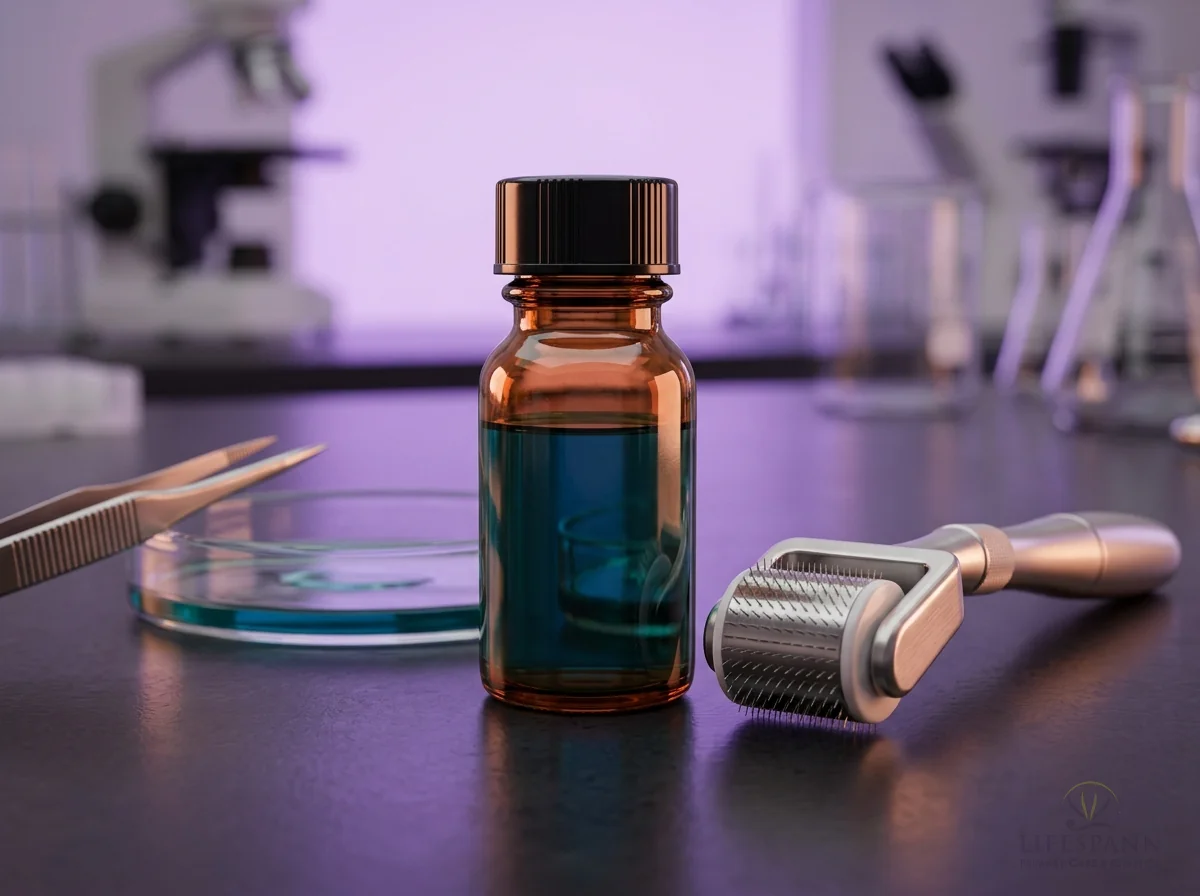
Understand the topic before choosing a treatment
GHK-Cu is a small copper-binding peptide studied in skin and tissue-remodeling research. It attracts interest from people concerned about skin texture, visible aging and hair changes.
The product and route matter. A topical cosmetic, an injected preparation and a laboratory experiment should not be described as if they provide the same evidence or result.
This is an educational guide. It does not establish product availability or that this option is suitable for you.
How it works—and what that tells us
GHK binds copper. Experiments with fibroblasts—the cells involved in connective tissue—have examined changes in matrix production and remodeling signals. Those findings help explain scientific interest without predicting an individual cosmetic outcome.
A mechanism explains how something may act.
Clinical studies test benefits and harms in specific people.
Your goals and health history shape the next step.
What the evidence shows
Cell-culture research
A fibroblast study found changes in matrix-remodeling enzyme activity after GHK-Cu exposure. This was not a clinical trial measuring wrinkles or hair growth.
Animal wound model
Rat wound-chamber research examined connective-tissue accumulation. It cannot establish equivalent effects from a consumer cream or systemic injection.
What it does not establish
- Claims about reversing biological age or reliably regrowing hair go beyond these sources.
- A percentage change in a laboratory measurement should not be advertised as the percentage improvement a patient can expect.
Safety questions worth discussing
- FDA identifies limited human safety data and immune-reaction concerns for injectable GHK-Cu.
- Tell the clinician about skin sensitivity, current products and recent cosmetic procedures before adding a new topical or procedure.
Bring your goals to the conversation
You can start with what you want to understand or improve. A consultation can help you assess the research and discuss other approaches; it does not commit you to a particular treatment.
- Is my main concern texture, pigmentation, irritation or hair loss?
- What evidence supports the exact route and product?
- Which established skin or hair options should I compare first?
Common questions about Copper Peptide (GHK-Cu)
Do copper-peptide creams prove injections work?
No. Evidence must match the formulation, route and outcome. Skin exposure and systemic exposure are different.
Does GHK-Cu reverse aging?
Laboratory remodeling research does not establish reversal of aging or longer life in people.
Can I use it around a skin procedure?
Ask the clinician performing the procedure. Timing, skin condition and the specific preparation matter; compatibility should not be assumed.
Sources and further reading
- GHK-Cu and matrix remodeling in fibroblast cultures
Life Sciences via PubMed · 2000 - GHK-Cu and connective tissue accumulation in rat wound models
Journal of Clinical Investigation via PubMed · 1993 - Bulk substances with potential significant safety risks
U.S. Food and Drug Administration · Current safety information
The cited sources describe particular products, study populations or research questions. They are not endorsements of a LifeSpann treatment. Meet our team.
Start with your goals. The consultation is free.
Free consultation · No deposit
Talk through what you want to achieve, the evidence, and the options worth considering. You do not need to choose a peptide or commit to treatment.
Our front desk will contact you within one business day to answer questions and schedule your consultation.
Prefer to call? (480) 351-7151